Zhengzhou Protech
Home > News

Product

Contact Us

Leave Message

Contact Us

All products are customizable, leave message immediately, we will reply as soon as possible.

Name

Tel/WhatsApp

E-mail *

Country *

Raw Materia

Message *

Verification code *

I can't see clearly, refresh

Atmosphere Furnace for C/C Composite Coating: 3D Printed Part Sintering Guide

1. IntroductionkloMuffle Furnace,Tube Furnace,Vacuum Furnace,Atmosphere Furnac
kloMuffle Furnace,Tube Furnace,Vacuum Furnace,Atmosphere Furnac
Carbon-Carbon (C/C) composite coatings are crucial for protecting 3D printed components in aerospace and high-end equipment manufacturing, thanks to their excellent high-temperature stability, low thermal conductivity, and good mechanical compatibility. 3D printed parts often have surface pores and defects, requiring precise sintering and coating preparation to enhance performance. As a key thermal equipment in controlled environments, atmosphere furnaces directly determine coating adhesion and component service life through atmosphere regulation and temperature control. This article details the application of atmosphere furnaces in C/C composite coating preparation, providing technical references for optimizing 3D printed part sintering processes.kloMuffle Furnace,Tube Furnace,Vacuum Furnace,Atmosphere Furnac
kloMuffle Furnace,Tube Furnace,Vacuum Furnace,Atmosphere Furnac
2. Core Roles of Atmosphere Furnaces in C/C Composite Coating PreparationkloMuffle Furnace,Tube Furnace,Vacuum Furnace,Atmosphere Furnac
kloMuffle Furnace,Tube Furnace,Vacuum Furnace,Atmosphere Furnac
2.1 Precise Reaction Environment Control to Inhibit OxidationkloMuffle Furnace,Tube Furnace,Vacuum Furnace,Atmosphere Furnac
kloMuffle Furnace,Tube Furnace,Vacuum Furnace,Atmosphere Furnac
During C/C coating preparation, carbon is prone to reacting with oxygen at high temperatures to form CO₂, causing coating peeling and performance degradation. Atmosphere furnaces can quickly replace internal air by introducing inert gases (argon, nitrogen) or reducing gases (hydrogen), controlling oxygen content below 10ppm to build an oxygen-free reaction environment. For the porous structure of 3D printed parts, the forced convection design of atmosphere furnaces ensures uniform atmosphere distribution, avoiding local oxidation-induced microcracks and laying a foundation for tight bonding between the coating and substrate.kloMuffle Furnace,Tube Furnace,Vacuum Furnace,Atmosphere Furnac
 
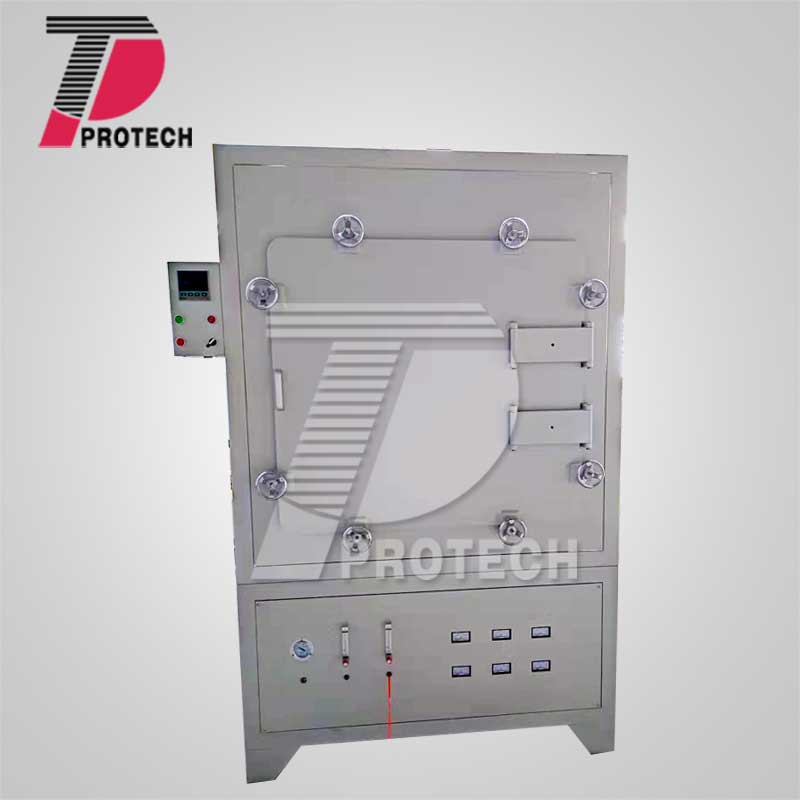
atmosphere furnace
kloMuffle Furnace,Tube Furnace,Vacuum Furnace,Atmosphere Furnac
2.2 Gradient Temperature Control for Optimized Coating StructurekloMuffle Furnace,Tube Furnace,Vacuum Furnace,Atmosphere Furnac
kloMuffle Furnace,Tube Furnace,Vacuum Furnace,Atmosphere Furnac
Sintering and coating preparation of 3D printed parts (e.g., carbon fiber-reinforced components) involve three stages: heating, heat preservation, and cooling, each with distinct temperature rate requirements. Atmosphere furnaces feature multi-stage programmable temperature control, enabling gradient heating at 0-10℃/min. Residual molding aids are removed from the component surface during preheating (200-400℃), while constant temperature is maintained during high-temperature sintering (1200-1800℃) to promote diffusion reaction between carbon sources and the substrate, forming a dense C/C composite coating. Additionally, the furnace's thermal insulation design reduces temperature loss, ensuring a temperature uniformity error of ≤±5℃ across the component to avoid deformation caused by thermal stress.kloMuffle Furnace,Tube Furnace,Vacuum Furnace,Atmosphere Furnac
kloMuffle Furnace,Tube Furnace,Vacuum Furnace,Atmosphere Furnac
2.3 Compatibility with Multiple Processes for FlexibilitykloMuffle Furnace,Tube Furnace,Vacuum Furnace,Atmosphere Furnac
kloMuffle Furnace,Tube Furnace,Vacuum Furnace,Atmosphere Furnac
To meet C/C coating preparation needs of different 3D printed materials (resin-based, metal matrix composites), atmosphere furnaces are compatible with various processes such as Chemical Vapor Deposition (CVD) and liquid impregnation-carbonization. By adjusting internal atmosphere pressure (0.1-0.5MPa) and gas flow rate (5-50L/min), coating deposition rate and thickness can be precisely controlled, catering to the preparation of ultra-thin protective coatings (5-10μm) and thick-walled structural coatings (50-100μm). Moreover, some high-end atmosphere furnaces offer vacuum-atmosphere switching, allowing vacuum pumping to remove impurities before introducing target gases, further improving coating purity.kloMuffle Furnace,Tube Furnace,Vacuum Furnace,Atmosphere Furnac
kloMuffle Furnace,Tube Furnace,Vacuum Furnace,Atmosphere Furnac
3. Operational Points of Atmosphere Furnaces for C/C Coating Preparation on 3D Printed PartskloMuffle Furnace,Tube Furnace,Vacuum Furnace,Atmosphere Furnac
kloMuffle Furnace,Tube Furnace,Vacuum Furnace,Atmosphere Furnac
3.1 Preparations: Component Pretreatment and Atmosphere DebuggingkloMuffle Furnace,Tube Furnace,Vacuum Furnace,Atmosphere Furnac
kloMuffle Furnace,Tube Furnace,Vacuum Furnace,Atmosphere Furnac
3D printed parts must undergo grinding and degreasing to remove surface burrs and residual organics, preventing bubbles during sintering that affect coating adhesion. Before startup, check the furnace's airtightness (leakage rate ≤0.01MPa/h) and purge gas pipelines to remove residual moisture and impurities. Configure gas ratios based on process requirements—for example, when using an argon-hydrogen mixture (9:1 volume ratio), calibrate gas flowmeters in advance to ensure proportion accuracy.kloMuffle Furnace,Tube Furnace,Vacuum Furnace,Atmosphere Furnac
kloMuffle Furnace,Tube Furnace,Vacuum Furnace,Atmosphere Furnac
3.2 Process Parameter Setting: Synergistic Control of Temperature and AtmospherekloMuffle Furnace,Tube Furnace,Vacuum Furnace,Atmosphere Furnac
kloMuffle Furnace,Tube Furnace,Vacuum Furnace,Atmosphere Furnac
Taking CVD-based C/C coating preparation as an example, temperature setting should follow a "stepwise heating" principle: room temperature to 400℃ (5℃/min) with 1h heat preservation for degreasing; 400℃ to 1500℃ (3℃/min) with carbon source gas (e.g., methane) and diluent gas introduced, maintaining heat for 2-4h to complete coating deposition; natural cooling (≤8℃/min) in the cooling stage to avoid coating cracking from rapid temperature drop. Gas flow rate should be dynamically adjusted based on furnace volume to ensure full diffusion of carbon source gas while preventing excessive flow from scouring the component surface.kloMuffle Furnace,Tube Furnace,Vacuum Furnace,Atmosphere Furnac
kloMuffle Furnace,Tube Furnace,Vacuum Furnace,Atmosphere Furnac
3.3 Post-Processing: Coating Inspection and Equipment MaintenancekloMuffle Furnace,Tube Furnace,Vacuum Furnace,Atmosphere Furnac
kloMuffle Furnace,Tube Furnace,Vacuum Furnace,Atmosphere Furnac
After sintering, test coating thickness, adhesion, and density using methods such as Scanning Electron Microscopy (SEM) and scratch tests. Repeat sintering-deposition cycles if pores exist. After use, close gas valves promptly, clean residual carbon powder in the furnace cavity, inspect heating elements and seals for wear, and calibrate temperature sensors and flowmeters regularly to ensure long-term stable operation.kloMuffle Furnace,Tube Furnace,Vacuum Furnace,Atmosphere Furnac
kloMuffle Furnace,Tube Furnace,Vacuum Furnace,Atmosphere Furnac
4. Application Case and Effect VerificationkloMuffle Furnace,Tube Furnace,Vacuum Furnace,Atmosphere Furnac
kloMuffle Furnace,Tube Furnace,Vacuum Furnace,Atmosphere Furnac
An aerospace enterprise used Kejia Furnace atmosphere furnaces to prepare C/C composite coatings for 3D printed carbon fiber-reinforced resin matrix components. Process parameters: sintering temperature 1600℃, heat preservation for 3h, argon protective atmosphere (20L/min flow rate), oxygen content ≤5ppm. Tests showed coating thickness uniformity of ±2μm, adhesion ≥35MPa, and no peeling or oxidation after 200h of heat preservation at 1200℃. The mechanical properties of coated components were improved by over 40% compared to uncoated parts, fully meeting the requirements of aero-engine components.kloMuffle Furnace,Tube Furnace,Vacuum Furnace,Atmosphere Furnac
kloMuffle Furnace,Tube Furnace,Vacuum Furnace,Atmosphere Furnac
5. ConclusionkloMuffle Furnace,Tube Furnace,Vacuum Furnace,Atmosphere Furnac
kloMuffle Furnace,Tube Furnace,Vacuum Furnace,Atmosphere Furnac
Atmosphere furnaces, with their precise environmental and temperature control capabilities, have become core equipment for C/C composite coating preparation on 3D printed parts, directly influencing coating quality and component reliability. In practical applications, process parameters should be optimized based on 3D printing material characteristics and coating requirements to achieve synergistic matching of atmosphere, temperature, and process. As high-end manufacturing demands higher component protection performance, atmosphere furnaces will upgrade toward intelligence and high precision, further promoting the wide application of C/C composite coating technology in 3D printing.kloMuffle Furnace,Tube Furnace,Vacuum Furnace,Atmosphere Furnac
kloMuffle Furnace,Tube Furnace,Vacuum Furnace,Atmosphere Furnac
Zhengzhou Protech Technology Co.,LTD is a professional manufacturer specializing in tube furnaces, muffle furnaces, atmosphere furnaces, and vacuum furnaces. We are committed to providing targeted solutions to meet your diverse heating equipment needs.kloMuffle Furnace,Tube Furnace,Vacuum Furnace,Atmosphere Furnac
For customized heating solutions tailored to your specific requirements, feel free to get in touch with us:kloMuffle Furnace,Tube Furnace,Vacuum Furnace,Atmosphere Furnac
WhatsApp: +86 17719806024kloMuffle Furnace,Tube Furnace,Vacuum Furnace,Atmosphere Furnac
Email: info@lab-furnace.com